

Beer, Baseball, and Being the Best in Japan
The festival I believed was the best in Japan turned out to be the worst. I lost something. And then I decided to make something else the best in Japan instead. That is the story I want to tell today.
Let me say up front: this is a baseball story. Japanese professional baseball, and it happened thirty years ago. Japanese pro baseball is split into two leagues, the Central League and the Pacific League, and back then the two were treated very differently. This is also a story about that gap.
One more thing, because it matters. In Japan we say "Nihon-ichi," which means literally "number one in Japan." It is what we call the national champion in baseball. It is also what people say about a local festival they are proud of. The same phrase runs through both halves of this story.
The year I lost something
I have written elsewhere about why I quit our local festival, so I will not repeat it here. I traveled to Kyoto, and there I realized that the thing I had believed was the best in Japan was not. That is all.
At the end of that article I wrote this: I should have realized sooner, and I should have found something else to enjoy.
Today's story is about that something else. The timing lines up exactly. Right in the middle of my growing disgust with the festival, word reached me that the Hawks would be playing a game in Akita. That is where my serious baseball watching began.
In the year I lost something, I went out to look at the replacement. That is the order things happened in.
Let me be honest
Before the main story, let me be honest about how my loyalties moved around.
Until the end of high school I supported the Yomiuri Giants. What else was I going to do? Television, newspapers, radio, all of them shouted Giants, Giants, Giants. I had no particular reason to turn against them. The Giants were a Central League club, and back then you could almost say that in Japan, professional baseball meant the Giants.
And then, somewhere along the way, I got bored of them. I suppose my personality is a little bent.
Why exactly was I not allowed to support another club?
When you think about it, there is no law against it. There was no law, but the atmosphere at the time came fairly close to one. Around then, Yutaka Matsumoto joined the Taiyo Whales, and that alone was enough. I became a Whales fan and supported the Whales.
Meeting Abu-san
That was when I came across "Abu-san," the manga by Shinji Mizushima.
"Abu-san" follows a fictional player through the Nankai Hawks, the Fukuoka Daiei Hawks, and the Fukuoka SoftBank Hawks. The hero, Yasutake Kageura, known as Abu-san, is a heavy-drinking pinch hitter, the kind of man who would give any real front office a headache.
And the club he plays for is a Pacific League club.
Kageura was exactly my kind of player, and before I knew it I had become a Hawks fan.
But here is the thing. It was the same professional baseball, and yet in those days the Pacific League was treated as dead weight. You turned on the television and what you saw was a Central League game. Around where I live, if you said you supported the Pacific League, people gave you a look that asked whether you were right in the head.
Even though the Pacific League was the stronger of the two.
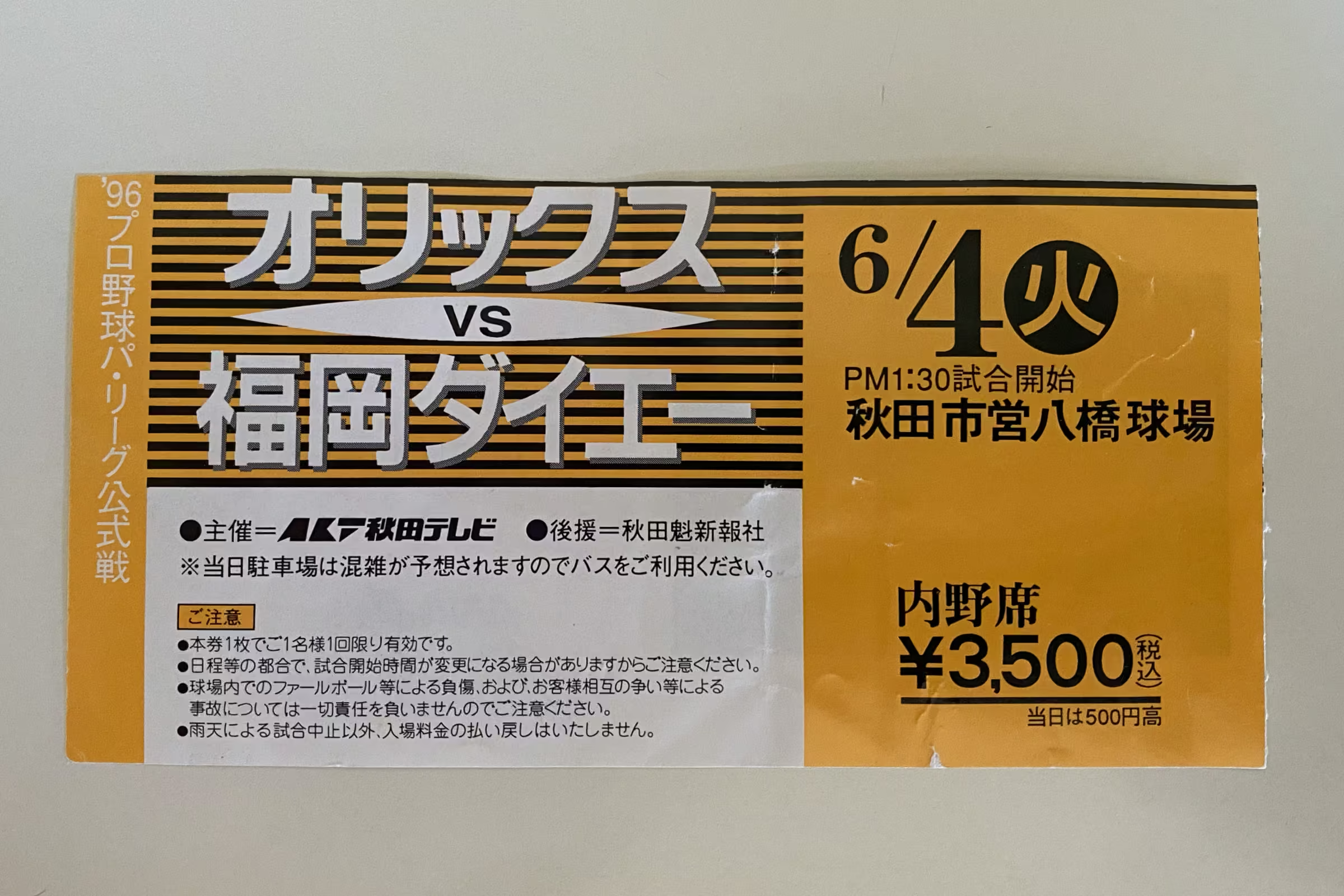
Year one: June 4, 1996, Yabase Stadium
The Hawks were coming to Akita.
Of course I was happy. A team that never appeared on television, a team that got me treated as an oddball for supporting it, was going to be right there in front of me.
Then it rained the night before. Rained hard enough that I half gave up and assumed the game would be called off.
Morning came and the sky cleared. It was a day game.
June 4, 1996, a Tuesday. Akita Municipal Yabase Stadium, now Sakigake Yabase Stadium. Orix against the Hawks. Attendance 19,000. My first game in a ballpark.
Daiei 000 000 021 = 3 (9 hits, 0 errors)
Orix 000 201 10x = 4 (10 hits, 0 errors)
We lost, four to three.
Two things from that day are still perfectly clear to me.
The first. During batting practice before the game I shouted "Reimer!" at the Hawks' foreign outfielder. The man standing there was Scott Lydy. Not Reimer.
In my defense, there is an explanation. Kevin Reimer had been Daiei's foreign player until the previous season, and Lydy was signed after Reimer's form collapsed. Lydy inherited Reimer's uniform number 47 exactly as it was. Same number, same import slot, same position. Frankly, getting it wrong is the natural thing to do. It was not my fault. Probably.
I do not remember what Lydy's face did. What I remember is Hiroshi Fujimoto standing nearby, looking thoroughly puzzled.
I looked up the box score afterwards. It reads as follows.
- Scott Lydy, the man whose name I got wrong: 0 for 3, three strikeouts.
- Hiroshi Fujimoto, the man who looked puzzled: 3 for 4, including a home run.
Life is generally like that. And while we are here, Ichiro homered for Orix in the same game. I had not gotten his name wrong and he hit one anyway.
But that is not what I remember most about that day.
A white ball climbing into a sky that had been pouring rain the night before. Fujimoto's home run was beautiful.
The second thing. The infield seats were no fun to cheer from, so I moved out to the outfield. I had paid for a good seat and then walked away from it. But if you are going to support a team seriously, sitting near the infield is not for me. No idea about now.
While I am at it, here is how I watched a game in those days.
Pack a cooler box with beer and carry it into the ballpark. Drink while you watch. When the box runs dry, go to the kiosk and buy draft beer. Then cheer, pleasantly drunk.
Every ballpark bans outside drinks now, as far as I know, so there is no copying this. It was simply that kind of era.
As for the game itself, the Hawks had scored nothing through seven innings. Nothing to four. Then two in the eighth and one in the ninth. We closed to within a run, and there it ended.
We did not get there. We did not get there, but a team that had been silent for seven innings scored three in the last two. What was happening in that ballpark of 19,000 people, I think, does not need writing down.
That was how my first year ended.

Year two: June 1997, the Michinoku Series
The following year the Hawks came back to the Tohoku region. Three games against Seibu this time. One in Yamagata, two in Miyagi. Michinoku is the old name for this part of the country, and the series was named after it.
I went to all three. Outfield seats all three days. No more infield for me. And the cooler box came along, naturally.
These three days are the heart of my story.
[Game one] June 24, Yamagata Prefectural Baseball Stadium (now Yamaryo Stadium Yamagata), 18,000
Daiei 000 010 310 2 = 7 (10 hits, 2 errors)
Seibu 221 000 000 0 = 5 (11 hits, 3 errors)
Nothing to five through three innings. Our starter, Kimiyasu Kudo, gave up eight hits and five runs in three innings and sank there.
Normally that is the end of it.
Then one in the fifth. Three in the seventh. One in the eighth. Level. And two more in the top of the tenth. Seven to five.
Koji Akiyama, who had come to the Hawks from Seibu, went 3 for 5 with four runs batted in and a home run. Ryo Kawano hit two. Between them, that is more or less the whole scoreboard.
[Game two] June 25, Miyagi Prefectural Baseball Stadium (now Rakuten Mobile Park Miyagi), 18,000
Daiei 301 100 022 = 9 (9 hits, 0 errors)
Seibu 000 000 010 = 1 (6 hits, 2 errors)
Three runs in the first inning. After that, you can read the rest yourself.
Shintaro Yoshitake went the full nine and gave up one run. At the plate, Akiyama hit two, Hiroki Kokubo hit one, and Kawano hit another.
That gave Akiyama three home runs in the series, and Kawano three as well. Six between the two of them. Akiyama, did your old club do something to you?
That day's beer was the best of the three. I could watch in comfort, after all.
For the record, this has nothing to do with Abu-san. Probably.
[Game three] June 26, Miyagi Prefectural Baseball Stadium, 16,000
Daiei 100 200 103 02 = 9 (20 hits, 0 errors)
Seibu 200 000 050 01 = 8 (16 hits, 1 error)
Four to two through seven innings. A perfectly decent position.
In the eighth, Seibu scored five in one go. Four to seven.
You can imagine what happened to the air in the outfield. A two-run lead flipped, and flipped by five. Two innings left.
Three runs in the ninth. Seven all.
And in the eleventh, two more. Seibu got one back. Nine to eight.
Eleven innings, twenty hits. Not one home run that day. Nine runs built out of twenty singles and doubles. Kokubo went 4 for 6 with three runs batted in. I was on my feet in the outfield the whole time. Pleasantly drunk is the wrong phrase. Somewhere in there the drink wore off entirely.
What those three days actually were
I noticed something while looking all this up to write it.
Seibu won the Pacific League that season. They were the champions.
What I watched in Tohoku was three straight days of the eventual champions being beaten in provincial ballparks. Game one from five runs down, in extra innings. Game three after conceding five in the eighth.
I still have the tickets.
Would you give up?
If your team or your sport is losing by a wide margin, do you stop cheering?
I do the opposite. I burn hotter. Although, to be honest, the number of times that cheering actually turns a game around is maybe one in ten. Maybe fewer.
People ask me whether cheering really does anything. They tell me you cannot turn a loss into a win.
But you can. It really does happen. Through cheering, or rather, you can feel the moment when the air in a ballpark turns from losing to winning.
What happens to a ballpark that is five runs down after three innings, by the seventh. What happens to a ballpark that has just conceded five in the eighth, by the ninth. I have watched both of those from the outfield.
And then everyone there shares the win and celebrates together, without anyone starting it. With complete strangers.
That, I think, is what I lost when I left the festival.
The part where it pays off
Let me finish with what happened afterwards.
In 1996, the year I watched us lose at Yabase Stadium, Orix went on to take the Pacific League and then beat the Giants four games to one in the Japan Series to become the best in Japan. Yes, those Giants. The ones I supported until the end of high school.
The Hawks got there three years later. What I was doing that night would take too long to write, so I will save it for another day.
And now they are a perennial contender.
The Pacific League itself changed too. At some point it passed the Central League in both strength and popularity, and nobody calls it dead weight anymore. Thirty years, and the whole thing turned over.
The thing I believed was the best in Japan stopped being the best in Japan, for me. And in its place, the one everybody said would never be the best in Japan became exactly that.
Keep going and one day it pays off.


