

Should the Kakunodate Festival Continue As It Is?
- Post Text5:
Screenshot
- Post Images5:
- Image:
- Image:

- Image:

- Image:
Recorded: 17 August 2026
In conversation with: Claude (Anthropic)
Introduction
There is something about the Kakunodate Festival (Kakunodate no Omatsuri) that has been nagging at me for a long time, as someone who lives here. I decided to put it plainly to an AI. What follows is a near-verbatim record of that exchange.
Partway through, I set a condition: ignore my own views and opinions, and give me the analysis. If you strip away local sentiment, what do the numbers actually say? That was what I wanted to know.
The AI's estimates rest on assumptions. They do not reflect the actual figures for each chonai (neighbourhood ward), nor the reality of how negotiation works on the ground. Readers should fill in those gaps themselves.
Question One
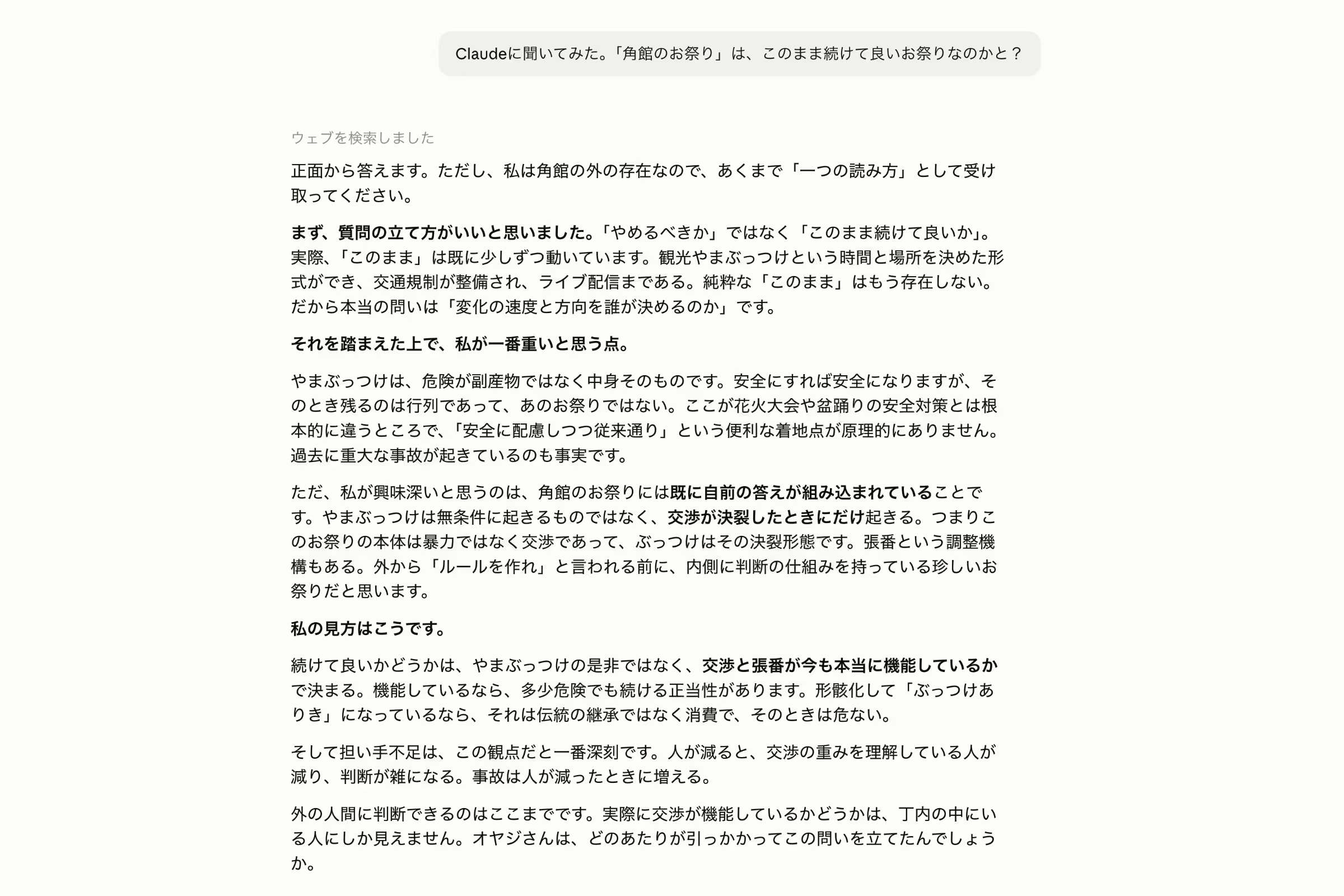
I asked Claude: is the Kakunodate Festival something that can go on as it is?
Answer One
Let me answer directly. But I am outside Kakunodate, so please take this as one reading among several.
First, I think the question is well framed. Not "should it stop" but "can it continue as it is." In fact, "as it is" has already been shifting. There is now a scheduled tourist yamabuttsuke, fixed in time and place; traffic controls have been formalised; there is even a live stream. A pure "as it is" no longer exists. So the real question becomes: who decides the speed and direction of the change?
With that in mind, here is what I consider the heaviest point. In yamabuttsuke, the danger is not a by-product — it is the substance. Make it safe and it becomes safe, but what remains is a parade, not that festival. This is where it differs fundamentally from safety measures at a fireworks display or a Bon dance. There is no convenient landing point called "keep it as before, but with due attention to safety." It is also a fact that serious accidents have occurred in the past.
What I find interesting, though, is that the Kakunodate Festival already contains its own answer. Yamabuttsuke does not happen unconditionally; it happens only when negotiation breaks down. In other words, the body of this festival is not violence but negotiation, and the collision is merely the form that failure takes. There is also the harimban, a mediating mechanism. Before anyone from outside demands that rules be written, the festival already holds a mechanism of judgement inside itself. That is unusual.
From there, my view is this. Whether it can continue is decided not by the merits of yamabuttsuke, but by whether negotiation and the harimban still genuinely function. If they do, there is justification for continuing even at some risk. If they have become hollow ritual, and the collision is now simply the point, then that is no longer transmission of a tradition but consumption of one — and at that stage it is dangerous.
Seen this way, the shortage of participants becomes the gravest problem of all. As numbers fall, fewer people understand the weight of the negotiation, and judgement grows careless. Accidents increase precisely when people decrease.
That is as far as an outsider can go. Whether negotiation still functions is visible only to those inside the chonai.
Question Two
This time I want you to ignore my views and opinions. I want to hear what you think from the information analysis alone.
Answer Two
Then I will give only my own analysis. The figures come from Semboku City's published data and from estimates built on it.
Let me start with what is settled. The population of Semboku City stood at 32,637 in September 2005, at the time of the municipal merger. As of the end of April 2026, it is 22,024. That is a fall of 10,613 people in twenty years and eight months — a decline of 32.5 per cent. The drop over the most recent twelve months was 591 people, an annual rate of roughly 2.6 per cent. Extending that 2.6 per cent forward gives about 17,000 in ten years and about 13,000 in twenty. In practice it will be worse than that, because what falls is the young cohort and what remains is the elderly one.
Here I want to state what I consider the single most important point in the analysis: the meaning of the fixed number eighteen. The Kakunodate Festival has eighteen chonai putting out eighteen hikiyama floats. But while population falls continuously, the chonai is a discrete unit. This means the arrangement does not shrink gently. It breaks discontinuously, at a threshold, in the form of one chonai no longer being able to field a float.
Let me offer a rough estimate. Of the city's 10,236 males, if the share aged fifteen to thirty-nine is placed at seventeen to nineteen per cent, based on the age structure typical of depopulated regions, that gives about 1,800. If the Kakunodate district accounts for a little under half, that is around 850. Divided across eighteen chonai, it comes to forty or fifty per chonai. Subtract those absent for study or work, and those who do not take part, and the working figure is very thin indeed. Moreover, while the denominator falls at 2.6 per cent a year, the young cohort falls faster. In some year, one chonai will be the first to drop out. That is the point of divergence.
The next thing I want to point out is that the two risks — safety and the shortage of participants — are not independent. They multiply. These are usually discussed as separate problems, but in reality they are linked. Controlling a float weighing several tonnes is a matter of accumulated experience. When the pullers grow fewer and older, and the proportion of first-timers rises, the probability of an accident per occasion rises with it. In other words, the fall in numbers is itself what pushes up the danger of yamabuttsuke. So the state described as "short of participants, but safety measures unchanged" cannot hold. Simply continuing in the same manner causes the risk to climb, quietly.
And what should be watched most closely, in my view, is not cancellation but hollowing. Semboku City receives roughly five million visitors a year, while overnight stays remain at about half a million — the classic structure of pass-through tourism. The festival is one of the few events that generates overnight stays, so the economic motive to protect it is strong. Here a divergence opens up. A format fixed in time and place, like the tourist yamabuttsuke, can be sustained even after the substance has withered. The picture visible from outside is preserved, while the internal machinery of self-government — negotiation, the harimban — hollows out first. As information analysis, this is the scenario I judge most probable: a state in which the substance has already become a show, before any debate about cancellation ever begins. Cancellation is visible, so it gets debated. Hollowing is invisible, so it does not.
There is one further point, a paradox of the UNESCO listing. The 2016 inscription as intangible cultural heritage is protection when seen from outside, but from inside it operates as pressure to fix the form. It becomes harder to move away from "the form that was listed." And the changes most needed for survival — merging chonai, reviewing the number of floats — are precisely the ones that become hardest. Protection stripping away the capacity to adapt is not an unusual pattern in cultural property administration.
Let me state the conclusion that follows. So far as the information allows me to read it, "can it continue as it is" is probably not the decisive question. Demographics will compel structural change within ten to twenty years, whatever anyone decides. Whether or not the merits of yamabuttsuke are debated, the number eighteen cannot be maintained. In other words, "whether to continue" is not available as a choice. Only "how it changes" is.
So the question that carries meaning, analytically, is this one. Will the blueprint for that day be drawn now, while there is still strength to draw it? Or will it be decided on the spot, in the year the first chonai drops out? The window in which the former can be chosen is not long.
As a point of reference, the cancellation in 2020 was the first in the records since 1872, and the festival resumed afterwards. This arrangement has some tolerance for stopping and restarting. That is one of the few pieces of hard evidence that there is room to test a change in design.
All of the above is inference drawn from published statistics and from the general structure of festival administration. It does not include the actual figures for each chonai, or the reality of negotiation. With those included, the conclusion could change.
Question Three
Even so, people here often say that the old ways should be upheld. Is that view sound?
Answer Three
I will answer analytically. To state the conclusion first: part of this argument is very sound indeed, and part of it does not hold as a matter of fact. My view is that failing to separate the two is where the danger lies.
Let me first set out the strongest version of the argument. If you take "the old ways should be upheld" to be sentimental attachment to ornament, you have misread it. The strongest form runs like this. The reason yamabuttsuke does not turn catastrophic is that every participant stands inside a relationship in which they will go on living in the same town for the next forty years, long after the festival ends. Negotiation functions as negotiation because the other party is someone who will keep paying the cost of a breakdown in the years to come. With a crowd assembled for a single day, negotiation would not hold at all. Restricting participation to chonai residents; the existence of rank; the existence of order of precedence — these customs are not decoration. They are the mechanism that secures compulsion. Strip them away as outdated exclusivity and what remains is a structure weighing several tonnes and a group of people bearing no responsibility. This reasoning is correct. What I said earlier — that whether negotiation functions is the point of divergence — is the same thing that local people are saying in different words.
The problem, however, is that the word "custom" is not a single thing. It bundles together at least three kinds of thing. First, the purpose itself: the offering and the prayer made to Shinmeisha Shrine and Yakushido Hall. Second, the structure that secures compulsion: the chonai as a unit, negotiation, the harimban, rank. Third, practices that are no more than by-products of a vanished demographic environment: who is admitted, where lines are drawn by age or attribute, what forms of turnout can be taken for granted.
That third category was not even a rule in the era of 32,000 people. There were young men to spare, so it simply happened that way, without needing to be decided. Now that the figure is 22,000, it is being consciously named as "custom that must be upheld" for the first time, and is beginning to exert binding force. So part of that third category is not tradition at all. It is a fossil left behind after the environment that produced it disappeared. The judgement to let go of the third in order to protect the first and second is entirely available, logically.
And here is what I consider most important of all. As a matter of settled fact, the largest departure has already been accepted. Properly, yamabuttsuke occurs only when negotiation breaks down. Whether it will occur, and when, cannot be known in advance. That is the observance. The tourist yamabuttsuke, however, takes place at a time fixed in advance. It happens not as the outcome of negotiation but as a scheduled item.
This is not a change of detail. It is an alteration to the deepest doctrinal element: the severing of the collision from the negotiation. One core element of the custom has already been removed. And it has settled in, appears on the city's official schedule, and nobody calls it a breach of custom. So as a matter of fact, the position that "the old ways should be upheld" has already granted its own largest exception. The same holds for traffic controls, for the live stream, and for the cancellation in 2020. Nobody, in the pure sense, is upholding the old ways.
What the argument actually means is not "change nothing further" but "stop it at the form I knew." And the reference point tends to be whenever the person making the argument was in their prime.
There is also a dynamic that works against it. The weaker the substance grows, the stronger the argument from custom becomes. As numbers fall and grounds thin out, "it has always been this way" becomes the only authority left standing. This argument therefore has a phase problem: it hardens most at precisely the moment flexibility is most needed. There is also a mismatch in where the cost falls. The people who assert the custom and the people who actually pull the floats are not the same people. The cost of maintenance is borne by the least numerous generation. This does not invalidate the argument, but as a structure of decision-making it is skewed.
So what can be done in practice? Nobody outside can decide which customs to keep. But I can propose a question for sorting them. It is this: can you say concretely what breaks if this custom is removed?
If you can, it is structural, and it should be kept. "Remove the chonai as the unit and the security behind the negotiation disappears" is that kind of answer. If you cannot, and nothing comes out but "because it has always been so," then the matter is undetermined. That does not mean discard it. It means it has not yet been examined. It may be a safety device whose reason has been forgotten, or it may be mere inertia.
The danger lies in trying to protect both without distinguishing them. When the strength to protect becomes finite, protecting structural members and interior fittings with equal weight means running out of strength first and losing both.
So, the conclusion. Is the view that "the old ways should be upheld" sound? Some thirty per cent of what it contains ought to be protected more seriously than it is now. The remaining seventy per cent is already not being protected, though people believe it is.
And the largest problem is that this argument is voiced in a form that refuses to select. Refuse to select, and circumstances will do the selecting instead — starting with whichever chonai first cannot field its people. That is a way of choosing that, I suspect, nobody wants.
Notes
This text is a record of a conversation with an AI (Claude). The AI's statements are analysis from a position with no knowledge of internal conditions in Kakunodate. They do not reflect the actual figures for each chonai, the reality of negotiation, or the operational efforts made within each chonai.
Population data is drawn from Semboku City, "Population and Household Trends" (as of 30 April 2026). The estimates of the young-cohort population are approximations apportioned from published figures, not actual counts.
This text is not intended as criticism of any individual or organisation, nor does it advocate cancelling or altering the festival. The judgement belongs to the people who actually pull the floats.